
“My conscience wants vegetarianism to win over the world. And my subconscious is yearning for a piece of juicy meat. But what do I want?“
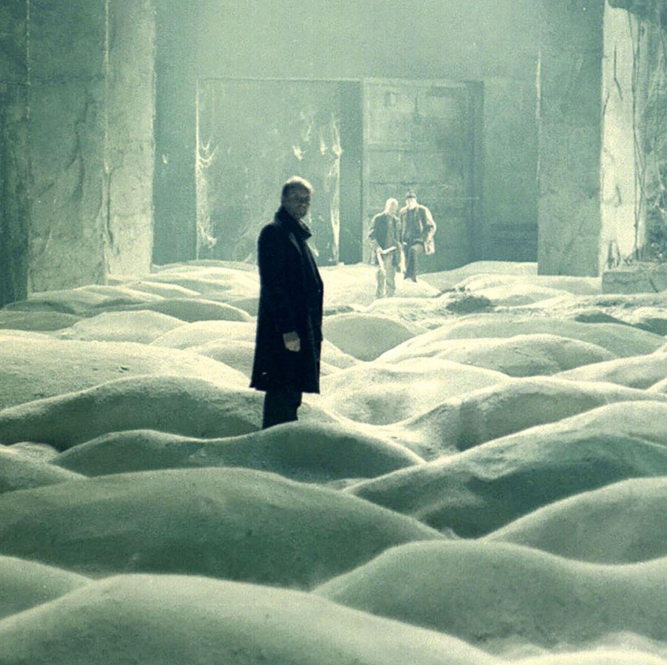
In an unknown sepia-soaked town somewhere in the far wastes of Eastern Europe lies an exclusion zone. What lies within said exclusion zone is kept hidden by a restrictive government, who themselves only know the very outskirts. Rumours say somewhere deep inside the desolate waste of abandoned factories and overgrown marshes lies a room that grants a person’s innermost subconscious desires. Only the bravest of men, the most faithful, venture inside, wishing to manifest their true desires. These people are donned “Stalkers” by society; rouge figures who illegally traverse The Zone, touring lost men through who wish to find what is inside.
This is the unique concept that belongs to Andrei Tarkovsky’s 1979 masterpiece, Stalker. Recently I have had the pleasure of rewatching Stalker in cinema, and what uniquely caught me is how deeply his philosophy and sincerity in discussing the theme of faith is.
It had been a long time since I watched Stalker. Part of me wondered if it would hold up to the standards I had placed it on previously. I had regarded it as one of my favourite movies. After this initial viewing, I had spent time exploring Tarkovsky’s other filmography, and what I noticed quite sincerely was the progression of how he develops his ideas throughout his experience growing as a filmmaker.
Tarkovsky deals deeply with the importance of faith within a culture. Deeply devout in his reverence to the Russian Orthodox church, many of Tarkovsky’s pieces play with the struggle to stay honest and loyal to a truth that lies within the church. He relates this a lot to personal growth as one goes through life, with childhood as a point of reverence, innocence and absolute truth. As one grows however, he becomes roughened and hardened to the world; normal truths a child would grasp become challenges of extreme intensity and struggle.
I believe this is mirrored within all of his filmography. Andrei Rublev is a historical drama about the necessity of faith to an artistic project, specifically Christian faith and its central importance to Russian identity. He portrays this through the titular 15th century artist and the period’s struggle against the Mongol Invasions. These are consistently portrayed as a hostile force beset on destroying all art produced by Rublev, and by relation, Russian civilisation.
This film constructs a struggle of the external. The Mongol invasions try to physically destroy the idea of faith through power and ruthlessness, yet all characters stay honest to the assumption that these ideas are true. This mirrors the state atheistic policies of the Soviet Union of the time. Tarkovsky struggled against the Soviet bureaucracy majorly when attempting to release this film. Initially being shown to the public at the Cannes Film Festival in 1967, Andrei Rublev never got a true release in the USSR until five years later; a cut which was heavily censored. The censors at the Central Committee of the Communist party at the time deemed it ideologically incorrect and incompatible with doctrines of State Atheism. Despite mass praise for his second major feature, the state posed a physical threat that repressed him at every corner.
Stalker develops heavily on this theme of faith. However, in line with Tarkovsky’s philosophy, the experience the primary character (simply donned Stalker) goes through is much more of a personal struggle than that of the external or of the state.
We open in the Stalker’s town, a world in which nihilism has already won. The truth of the church and the faith has been repressed. No image of belief or hope is shown. Drowned in a sepia camera, all life from the camera has left. Dead and sterile, the hidden authority within the film that governs the town has succeeded in its repression. Faith to the adult man has already been questioned and preassumed notions that the faith is true have disappeared to a world of doubt and superstition.
Tarkovsky seems to later venerate this childhood innocence when the Stalker comments that “When a man is born, he is soft and pliable. When he dies, he is strong and hard. When a tree grows, it is soft and pliable. But when it’s dry and hard, it dies. Hardness and strength are death’s companions. Flexibility and softness are the embodiment of life. That which has become hard shall not triumph.”
In fact, to the Stalker, the Zone itself represents faith. Hidden away, guarded by armed personnel, he dangerously ventures into the Zone to become one with it. Upon reaching the Zone, his first action is to embrace himself in nature and the flowers of the environment. This is embellished by the existence of colour within the environment, distancing itself from the sepia of the town. The Zone is not as desolate as the dialogue would originally have us believe and is filled with boundless wildlife upon entry.
If the Zone is a zone of faith for the Stalker, then his role within the film is that of a priest or spiritual guide. His livelihood consists of leading expeditions for those curious into the Zone at a cost. Here, he is saddled with a Writer in the midst of crisis and a quiet Scientist with ulterior motives. He takes these men on an expedition into the Zone which represents a danger challenging them to question what they truly know. He lays out the rules that explain how the Zone must be treated with respect and piety. He even outlines that the Zone is a living thing and respects only those who are truly honest yet in the pit of desperation.
Tarkovsky then layers in internal doubt within Stalker’s character. The crisis in the third act of the film consists of a moral debate: whether it is worth trying to save these two visitors who have truly lost all hope. Stalker says the Zone is a dangerous entity demanding respect and willing to kill at any time. The two visitors however slowly expose holes within the Stalker’s faith, as the two seemingly have very little trouble traversing the terrain. Yet it is mentioned that previously others are said to have died on expeditions. As an audience, we do not see these previous expeditions and so as viewers, our only perspective aligns with the Zone’s current visitors. It could be very possible that the Stalker is lying to both the characters and the audience about this, forcing all to doubt the Zone’s supernatural abilities.
The third act presents the degradation of the other visitors’ faiths to even enter the mystical room, believing that it might not even be worth finding out what someone truly, unconsciously desires; vast parts of the film are dedicated to this debate between the characters. The nihilism of Writer wins out, then the ugly, godless heart of humanity rears its head. Stalker, whose only goal was to grant these people what they truly desire, is broken by this, believing he has failed his mission as a spiritual guide. He is reduced to a crying mess, accepting he clings to the Zone as a matter of faith because it is all that he has.
Here, Tarkovsky presents a spiritual, internal struggle, threatening to break his devoted characters and plunge them into nihilism. What truly wounds faith in this film is not an immature barrage against iconography, the likes we see in his youthful cinematic productions. Here, it is the deeper questioning inside oneself and reluctance to give yourself over blindly to faith.
The final scene is always an interesting point of debate. Personally, I have always chosen to see it as the softness of the soul prevailing in line with the Stalker’s previous musings about softness and hardness. Tarkovsky reveres the innocence of childhood and uses it here as proof of faith in religion. Despite this, other people who I have discussed the film with see it as a mutation of the Zone, its energy seeping hopelessly into the real world.
One element I picked up in this watch which I didn’t previously was the commentary on the masses of humanity intrigued by the Zone. A central motivation of the scientist is the belief that this possibly alien technology could be harnessed to destroy the world. He comments: “what will happen when everyone believes in this Room and when they all come hurrying here. It’s only a question of time. Not today, but tomorrow. And in the thousands. All these would-be emperors, grand inquisitors, fuhrers of all shades. The so-called saviors of mankind! And not for money or inspiration, but to remake the world.”
The conflict here is whether it would be better to have an idol with the potential to suffocate the world, cause the deaths of millions, for a chance at achieving what one truly believes, or whether it’s better to have no faith at all.
Tarkovsky ultimately believes the hope of one man can absorb the entire world, and that it’s better for humans to strive towards an ideal than not strive at all. After all, Stalker says in the film: “Let everything that’s been planned come true. Let them believe. And let them have a laugh at their passions. Because what they call passion actually is not some emotional energy, but just the friction between their souls and the outside world.”
After Stalker, Tarkovsky’s filmography embodies the same desperate feeling of grasping to faith like the final act of the film. Nostalghia follows a man investigating a long-dead Russian composer who died in exile in Italy. During the final scenes of the film, the protagonist desperately attempts to traverse an empty pool with a lit candle, said to be impossible by members of the village he is based in. The long, drawn out sequence is tense with the man attempting to keep the light intact, analogous to keeping the faith alive. He claims doing so will allow him to save humanity from the end of the world. (A similar theme is played upon in Tarkovsky’s final film, The Sacrifice where a philosopher bargains with God to save the world from a nuclear holocaust.)
Adding to the desperation of the piece is the knowledge of Tarkovsky’s own self imposed exile in Italy. He moved away from the Soviet Union, fearing artistic restriction and state repression. Detached from the land so spiritually necessary to understanding the man’s filmography, Tarkovsky tries to keep the Russian soul and faith in Orthodoxy alive in a foreign land.
His later films are drenched in nihilism, and consistently feature a central character fighting to save the world by propping up a dying faith or attempting to inspire others. Compared to his earlier works, Tarkovsky’s later pieces are much more visceral, making the success of faith in the end so much more satisfying.
In retrospect, Tarkovsky’s Stalker definitely holds up to the pedestal I had placed it on. I respect that it is considered an untraditional film from an untraditional filmmaker. This might be alienating to some, perhaps those who have not explored the more expressionistic side of film. Despite this, I truly believe it is a film everybody should watch. I cannot promise everybody will enjoy its style or presentation, yet I can promise the poignancy of themes and philosophy is something that will leave most engaging with the piece with ideas to question as they go about their lives.