
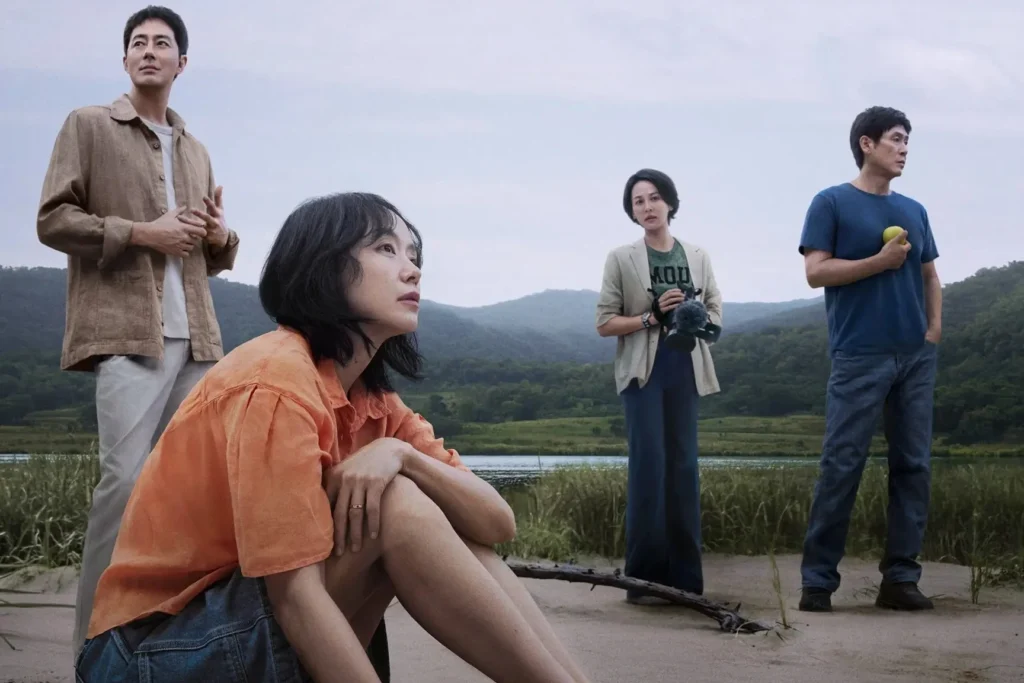
Possible Love was the culmination to the first week of the BFI London Film Festival on Tour, and also my introduction to the cinema of Lee Chang-Dong. This is a film about a family in the wake of a tragedy and the patriarch being laid off from work, who cross paths with a documentarian and her spouse. The four key players within this story then push at the boundaries of their relationships and begin to uncover hidden desires.
Possible Love works as the juncture of two tracks, which seem destined to come together in a complicated manner. It’s class conflict, it’s romance and it’s the role of documenting these facets of life. What is the role of a documentarian in such a fraught situation? The way in which Lee Chang-Dong and cinematographer Kim Ji-Yong utilise these wide shots throughout the film (themselves getting wider and wider, the more the faults between characters grow as the film’s conflicts bubble over) emphasise the distance between those who are privileged enough to be external voyeurs into these very real lives and those who are forced into being those being watched. It brings an uncomfortability to these situations as we the audience watch them unfurl and the class divide becomes more of a factor in even their interactions with each other. There’s a poisoning factor brought by the fact that the documentary is being involved. It’s manipulative and prying, and I believe that this incongruent factor into life is so perfectly captured by the oh-so-simple decision to have these singular moments brought to life with the static wide (and then extreme wide) shots.
This is an extremely grounded drama, no heightened flourishes or anything like that which means that everything constituting this film on a character level needs to be immaculate. The four lead characters (Mi-ok, Ho-seok, Sang-woo and Ye-ji) are interwoven in complicated ways for them which are easy to follow for us as the audience. The two couples harbour secret desires or thoughts about the way the other lives. By keeping it focused on, for the majority, only these four characters the world itself begins to feel more layered as we are given the opportunity to understand these people more fully. Emotions feel so much more impactful and the odd outburst carries with it more weight as a current of attempted emotional neutrality (these characters trying to maintain dignity by skirting around directly confronting their emotions). And the performances are so deeply entrenched in these nuanced layers of emotionality. There’s never a specific emotion evoked fully. There’s always a tinge of something else, such as regret or some longing which makes every scene uncomfortable to be in. It creates a sense of sympathy, especially for Mi-ok and Ho-seok without looking down on them at all for where they are within class hierarchies.
One thing which I also noticed while watching is the lack of non-diegetic music in the bulk of the film. By not using a score, there isn’t that subconscious manipulation of what is seen on camera. The audience is able to make up their own mind, which is what I think makes this film so memorable and effective at being properly thought provoking. The decision to leave the four focal characters on their own terms in this manner makes the conflicts at play all the more intimate, leaving them to simply exist in their own world. By doing so, director Lee makes every complication in these character dynamics take time naturally.
Of the incredible cast, the highlight is Jeon Do-yeon as Mi-ok, the wife to Ho-seok (the patriarch who was laid off from his job). The film revolves around her perspective for the bulk of the narrative and that minimalist emotionality is best conveyed by her. Other cast members have their time to shine and are incredible in their roles, but Jeon Do-yeon is giving one of the best performances of the year thus far as she is attempting to kind of overlook the deeper tragedy her family is going through while engaging with the documentarian and that maintaining of dignity that I mentioned earlier. She is phenomenal at evoking those complicated feelings, that crossroads between one’s desires and the quote unquote “right thing” whatever that may be. Her frailty, more so when paired with her blossoming desires, is something which I think is resonant as it contextualises the class dynamics in a way in which simple binaries are deconstructed. Her wants, I found, were the part of the film I was most invested in.
I haven’t been able to stop thinking about this film since I watched it and, over the course of that time, I have warmed significantly to it. I loved it initially, but its status as a modern masterpiece in my mind is something that was more gradual. It’s a slow-burn of a film, but the fact that it has the ability to linger pervasively, its moral questions on individual voice remaining weeks after first watching it, make it a masterwork in my opinion.
Possible Love: 5 stars