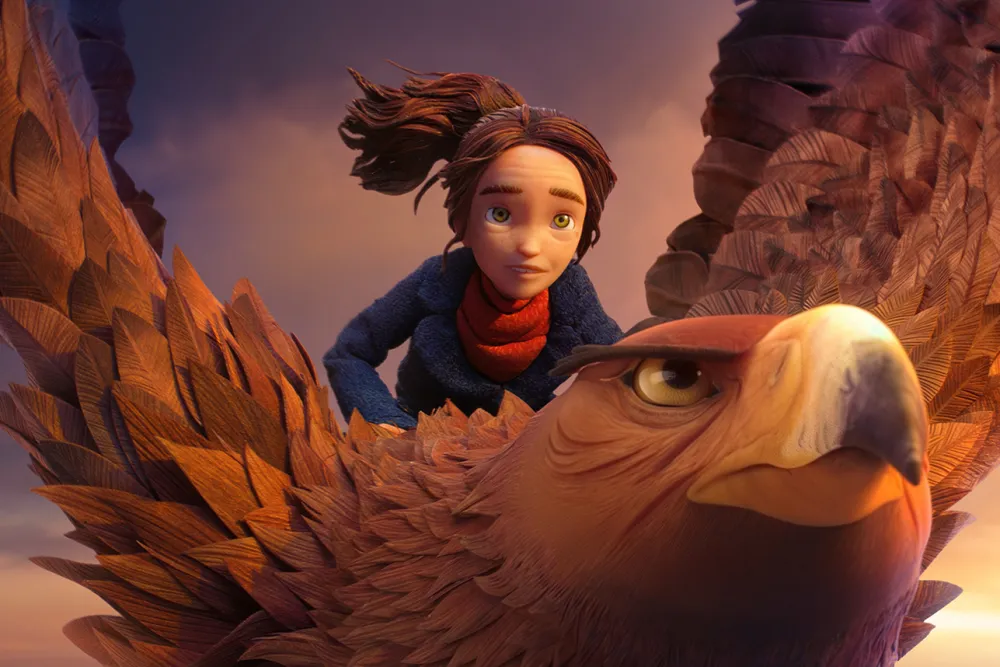
Wildwood, the first Laika film this decade and one that has reportedly been in some form of development for the better part of sixteen years, has finally been released in cinemas. Its story focuses on Prue, a headstrong girl along with a classmate, entering a magical forest just outside of Portland, Oregon, in order to save her abducted baby brother. In this forest, there’s a myriad of enchanted creatures and threats at every corner.
As is to be expected from Laika and their at-this-point legendary status as a studio, this film is an absolute marvel to behold. The stop-motion puppetry is simply on-point. The amount of time taken between the voice over and the actual puppetteering (about five years from what I’ve heard) doesn’t feel like enough to bring this film to life. It is just so detailed. A lot of people will be talking about the multi-stage battle sequence in the final act as the distillation of this pure cinematic magic that can be seen on screen. They wouldn’t be wrong to do so either. Seeing dozens and dozens of miniatures caught in their own actions, feeling alive and moving seemingly as if on their own accord, is obviously breath-taking. Under no circumstance am I going to even attempt to be a contrarian on that front, but what I haven’t seen as many people discuss is the minutiae. The film’s opening shot with wind (not strong wind, more like a gentle breeze) rustling past some ivy locked me in instantaneously. The very realistic movement of the leaves and stalks, nothing majorly in your face (especially when in discussion with that final fight scene) got the goosebumps going for me. There’s also a scene transition, early on in the first act, where Prue wakes up. The way in which her irises adjust to the light was nothing short of astounding. It feels like a privilege to see these details and, in my eyes, it was only really possible to do so early on while the plot is still warming up. That is not a negative; nowhere remotely close. What I mean by that is that as the film continues, those smaller details blend together and I nearly forgot a lot of the time that what I was watching was even hand-made. It feels like bona fide magic to see a film like this in cinemas right now.
But a technical marvel could still fall short on that oh-so-important component known as story and it would all be moot. It brings me great pleasure that this film has a great story to boot. Possibly a tad reductive, but it feels like a more mature version of Labyrinth, especially with an antagonistic figure who is such an interesting character to learn more about. This is a film about love and what one would do for those they love, and Alexandra is the perfect foil for Prue. You learn more about her as the story naturally goes on, but it’s fun as an audience member to see a villain in a film suitable for a younger audience that feels human and complex with a clear and yet humanly muddied emotional core. It feels sympathetic without room for transparent redemption. This story treats its audience with respect, and I might just only be aware of the poor examples as of late, but it’s a much-needed breath of fresh air to see a film that younger audiences could watch and, in turn, instill a love for cinema in them.
Another detail with Alexandra, the Dowager Governness, is the vocal performance from Carey Mulligan. There’s a heartbreaking emotional hollowness in the delivery of dialogue which really goes to sell the delusion she’s found herself in. The belief that what she is doing is, although evidently not moral, the correct course of action is strongly imbued into that guarded distraughtness. This is an all-timer vocal performance and it’s much-needed in making Alexandra the multi-faceted antagonist that makes this story much more interesting than if it had simply gone the prototypical fantasy route with the conventional good and evil binaries. And all of the nuances don’t get in the way of how terrifying she is. Mulligan has that overbearing presence, the coldness as an exterior to the mess of emotions that the audience is able to observe through cracks, borne of her delusion.
The only complaint I can muster up is itself incredibly minor. This is unfortunately a matter with the dialogue, typically from Prue. The way in which her dialogue is presented relies rather heavily on quipping and slinging one-liners somewhat frequently. It comes nowhere near derailing the experience of watching the beautiful creations onscreen and that heartfelt story, but it is unfortunately noticeable in small yet apparent doses. It could be explained that it’s because of her being a teenager and so the awkwardness of the dialogue is emblematic of that, but I’m not quite too sure if it’s effective at being an element of unique characterisation for her. Considering that that is, quite legitimately, my only complaint with the film (and it is a minor issue that I have, near negligible) the film is nothing short of extraordinary.
This is the type of film that I really want to see more of, something that has an unignorable human touch in both the observable craft and in the story. It feels like so long since there has been a film of this maturity made for a broader audience. I don’t know how to express how much I need people to flock to cinemas to see Wildwood. It is just that remarkable to see a film this intricately made.
Wildwood: 4.5 stars