On the 12th February 1912, China was officially a republic at the abdication of the 6 year old child-emperor. Tensions had been simmering for nearly twenty years before between the incompetent Imperial government and suppressed intellectual circles, teeming for the opportunity to establish China in their image.
China throughout the previous century had been relentlessly captured by foreign powers, termed the “Century of Humiliation,” starting with the First Opium War. This had forced the Chinese Emperor to open up the national market to import opium and other western products. An addicted, increasingly unemployed and deprived mass of people, revolutionary sentiment festered. China’s politics at the time was divided by a strict upper caste of Manchu ethnicity, with the majority Han Chinese being forced to adopt their foreign customs. Living as second class citizens in their own nation led to social strife. This only increased through several more crises, such as the Taiping Rebellion and the Second Opium War. Particularly of note was the Sino-Japanese war, which after sprung a planned uprising in Guangzhou.
Though the plan for this uprising was leaked and plotters executed, one escaped. Sun Yat Sen fled to the United States and would go on to be crucial in the establishment of a “new China.” His revolutionary society, the Revive China Society, would go on to be the ideological foundations of the later Nationalist Party, the Kuomintang.
The initial rallying cry of the society was:
“Expel Tatar barbarians, revive Zhonghua, and establish a unified government.”
The “Tatar barbarians” here referring to the Manchu ethnic minority, and “Zhonghua” referring to the Chinese idea of the nation. Today, both the Communist government of Mainland China and the Capitalist government occupying Taiwan claim ideological descent from Sun’s teachings.
It is interesting to note that the beginnings of this movement was explicitly ethno-nationalist, decrying the Manchu rulership as “barbarians” foreign to the Han Chinese sense of nationhood. Sun’s later policies would advocate for his principles applying to the Chinese or people of “Zhongguo”, selecting “Chinese ethnicities” as the ones with historical cultural ties under the subjugation of past Chinese states.
Sun travelled to diaspora communities in Los Angeles and gave several speeches in Europe to drum up support and funding for his movement. In Tokyo, 1905, a merger of the Revive China Society and several other small exile groups formed the Tongmenghui. Now critically organised, the group funded several failed uprisings in the beginning of the 20th century.
The merger folded in Socialist, Nationalist and Republican elements. In 1904, the movement slogan became:
“Expel the Manchu rulers, to revive Zhonghua, to establish a Republic, and to distribute land equally among the people.”
The 1905 manifesto for the party also outlined an initial concept of “The Three Principles of the people” as policy. These would go on to be Sun’s most major ideological project, outlining a programme of Nationalism, Democracy and Social Welfare.
Key to Sun’s idea of Nationalism now was a “yellow” versus “white” racial conflict, heavily based on the threat Western Powers posed to China’s sovereignty throughout the 19th Century. In Sun’s first lecture on Nationalism, (1924) he outlines the conditions that inform Chinese nationhood. Historical continuity, linguistic unity and livelihood were essential to the subgroup of the “yellow race” the Han Chinese represent. Their historical development has significantly lacked behind though, and if the Chinese people cannot foster their own “national spirit” as many other nations have, (China existing in a familial and clan-like structure) they will be subject to extinction by foreign colonialism. His was one of the world’s first examples of anti-imperialist nationalism, a style that would dominate many ex-colonial nations during the Cold War. He views China in his second lecture as a “hypo-colony,” a subject of all colonial powers at once, which suffers doubly due to the destruction it brings to Chinese society since said empires don’t need to retain political stability inside of it.
Sun’s view of history is interesting in that it takes many aspects from western liberal Whig History. He outlines in his first lecture on Democracy the progress from Theocracy, to Autocracy, to Democracy. This has similarities (or vague allusions) to Marx’s view of history, wherein to reach the stage of Democracy, a society must achieve the correct material conditions, where the people then have the ability to seize power for themselves. He also imbues this with a sense of cultural Nationalism, quoting the Confucian scholar Mencius. Specifically, his view of the importance of the masses to a political system, highlighting them as the core reason for the state existing. Sun personally sees Democracy as a selfless form of government which would avoid the civil strife of inter-dynastic wars, instead using the mechanism of political parties to contain violence for the wellbeing of all. There is also the distinction in Sun’s writing of a “false equality,” wherein all people of the former governmental system are brought to the same level. He believes this should be avoided as it does not align with the values of the state. The state, in Sun’s eyes, should valorise “The Genius” or “The Sage,” yet allowing all to stand on equal ground politically. This would allow these characteristics to emerge out of different parts of the former hierarchy. Equality as a blank term is rejected. People have a right to the ownership of the state, which is separated from the administration of the government.
Furthermore, Sun outlines Social Welfare as an extension of his progressive view of history. Taking from Maurice Williams’ critiques of Marx, Sun says that the primary driver of history is society. Dialectical materialism in this view is secondary: “Marx’s assumption that class struggle is a cause of social progress puts effect before cause.” (The principle of Livelihood: Lecture One) While in the West, Marxism had absorbed much of the political conversation surrounding social cohesion, China, a pre-industrial peasant country, was not within the stages of development for his critiques to be accurate. People, in Sun’s view, strive for social and cultural progression. Without these, economic organisations cannot improve as the culture, stagnant, is uncritical of it. Oppression will increase in order to compensate for this natural need. Sun is accounting here for the conditions that collapsed the Qing and many previous dynasties before. He does not mean Social Welfare in purely economic terms, but also morally and culturally. A revolutionary plan of national revitalisation would be necessary to make this come true. Within this, the national struggle is born. Successors of Sun would stylise themselves as the leaders of this struggle, and the ones willing to complete his mission.
In 1911, the Qing government announced the nationalisation of local provincial railway networks. Provinces had previously been allowed to organise and profit from railways autonomously due to most being funded by foreign powers after the Chinese market was forcibly opened up by Western Powers. Now, racked in war debt from the recent Boxer Rebellion, nationalisation was the only way to pay off said debt.
Unhappy military elements launched a minor rebellion in Wuchang as a response. Sun’s Tongmenghui was more than willing to provide funds. This rebellion slowly became something much bigger, with many revolts in major cities ousting the Imperial Government.
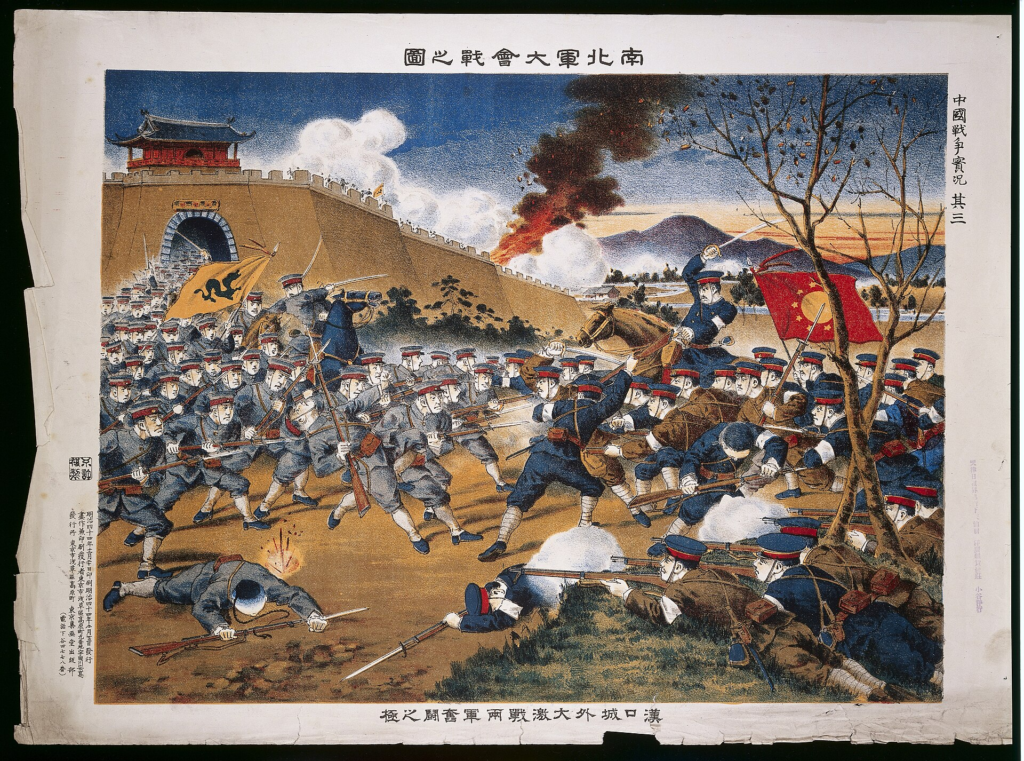
Sun Yat Sen returned to China, establishing a power base in the south (Nanjing) during the chaos. Military general Yuan Shikai established a power base in the North, (Beijing) pledging allegiance to the Republican movement in exchange for his role as Prime Minister. This backfired when Yuan began centralising power, assassinating key figures within the Republican movement, causing provincial revolt by fearful republicans aligned with Sun Yat Sen. Yuan’s Beiyang army marched south, capturing Nanjing, causing Sun to flee to Japan. Yuan then later proclaimed himself Emperor, fracturing the country further and sparking provincial armies to further secede. Sun’s China became a patchwork of warlords, bandit clans, cliques and armies claiming to wish to continue the Republic. The dream, though fractured, lived on.
Sun Yat Sen died in 1925 of liver cancer. Shortly after, the Kuomintang nationalists split three ways into rival factions, all claiming legitimacy to Sun’s legacy.
The 1917 Bolshevik revolution in Russia sent shockwaves throughout the world. Notably, in China, spillover from the Russian Civil War allowed Communist elements to influence the country. The Communist Manifesto was officially translated into Chinese in 1920 amidst the New Culture Movement, a period of cultural renaissance in China inextricably tied to the 1911 Revolution. Furthermore, following the Civil War, the Soviet government looked to China to spread influence. The relationship was more mutual than previous endeavours with European powers; The Soviet Union, seen as an international pariah, wished to gain recognition and political support, while Chinese factions benefitted from material support and Westernised techniques. Under Sun Yat Sen, the military of the Kuomintang was reorganised into a true fighting force by Soviet advisors.
The Gongchandang (Chinese Communist Party) was founded in 1921 in the Shanghai French Concession by a small but ideologically dedicated group of around 50 members. Communist elements soon became very active within the Chinese government, aiding the support of the Kuomintang against their mutual enemies.
The Chinese Communist ideology at this time was not fully what many expect it to be; it was ideologically constrained to a very traditional Marxist doctrine and was guided principally by the ideology of the Bolshevik Soviet Union. Many of the ideological differences that defined the Chinese road to Socialism were implemented after the collapse of the first United Front. Being tied to the ideas of Lenin, the party believed that in order to achieve Communism, a nation must first go through a “Borgeouis-Democratic” revolution.
In Red Star over China (1944) Edgar Snow outlines that “The Communists, of course, regarded the successful fulfilment of the “bourgeois-democratic” revolution as a necessary preliminary” to a Communist revolution in China. That is to say that, in its current stage, there was no ideological grievance between the polities of the Gonchandang and the Kuomintang. Sun Yat Sen explicitly outlines in his three principles several quasi-socialist principles. Land reform and Social Welfare in this sense can be viewed as explicitly Socialist. In its opening stages as a party, the Communists could get behind most, if not all principles of the Kuomintang, until the time for a proper Socialist revolution was necessary.
The Gonchandang to this day still consider Sun Yat Sen a founder of the People’s Republic of China. They see him as a necessary step towards their goal of achieving Communism due to these policies of Social Welfare and Democracy. From 1924 onwards, the Kuomintang and the Gonchandang formed a “United Front”. The aim of this United Front was to militarily suppress Warlordism and curb increasing Japanese Imperial presence, as well as carry out the internal reforms of Sun’s vision.
Japanese Colonialism further into China had begun with the Japanese victory against Russia in 1905. As part of the treaty, Port Arthur, a peninsular port holding of Russia, was ceded to the Japanese. To access the territory, Manchuria in Northeastern China, was informally under the control of Russia. This switched hands to Japan after the war. The Japanese invested heavily into modern resource extraction and manufacturing in the region. As a result, they later gained political control over the region once Zhang Zuolin took power amidst the Warlord Era. Increasingly, it became clear this manner of imperialism was not for China’s gain. In 1915, the Twenty-One demands were pushed, demanding further concessions to Japan in China’s internal affairs, territorial concessions and economic privileges.
Chiang Kai Shek increasingly centralised power within the KMT after the death of Sun Yat Sen. An esteemed military commander, he developed a cult following amongst the right wing of the party. Based in Nanjing, Chiang split from the elected government in Wuhan, which had been run by left-wing elements.
Chiang’s idea of Nationalism differed from that of Sun’s. While Sun may have taken an anti-imperialist stance towards forming nationhood, Chiang-Kai-Shek Thought aimed at internal cultural reforms, spurred by a military elite. His New Life movement aimed to reforge Chinese customs through referencing Confucian ideas of cleanliness. Chiang’s policies also grew from a skepticism towards the Soviet Union, seeing their encroachment as worse to the nation than that of the Japanese. Because of this, Chiang’s government was backed to some extent by Western “treaty port” bankers (Red Star over China, 1944) and Capitalists.
Despite his major mistrust of the Soviet Union, he effectively co-operated with the Communists for a good amount of his military leadership. The growth in their power led to suspicion, however and the United Front was seen by him as a way to control the Communist elements under the Nationalist umbrella.
This fell through and the United Front split in 1927 with the Shanghai Massacre: a purge of major Communist elements in Shanghai. The Northern Expedition against Warlordism was halted and Communists were forced to flee, establishing small “Soviets”. The dream of a united Chinese authority was lost and a bloody Civil War erupted, meanwhile the Japanese further encroached on the internal politics of the nation.
It is also important to note at this time the Wang Jingwei Government in Wuhan also committed its own purges on Communists, after believing itself to be the legitimate government. Originally supportive of the cause, this was to fall in line with Chiang. Wang was originally the chosen successor to Sun, collaborating with Communists due to a more left-wing stance.
Wang later fell in line behind Chiang, becoming Foreign Minister in Chiang’s government, where the opportunity was posed for collaboration with the Japanese. His calls for peace with Japan led to his expulsion from the Kuomintang, and then plotted to weaponise several warlords against Chiang with Japanese assistance. During the Second Sino-Japanese War, (The Chinese theatre of WWII) Wang led a Chinese puppet government fighting against the Second United Front.
This represents another personal grievance that caused a split in China throughout this period. Wang and Chiang were principally working towards the same goal of a renewed China under Kuomintang governance. Their ideological differences did not represent the reason behind the split as purging Communist elements was in line with party policy.
Similarly, it is unfair to say that the split between the Kuomintang and the Gongchandang was not due to petty personal disagreements. Willing to collaborate on most things, the Kuomintang decided to target the Communists only once they began gaining mass traction amongst the peasantry. Principally, these three factions were working towards the same goal; the fulfillment of Sun Yat Sen’s vision. What truly ruined this dream was not so much what one faction agreed with, compared to the other. The Kuomintang’s ideological core can be seen as sympathetic towards the Communist cause as with Wang Jingwei’s alliance with the Gongchandang and Chiang Kai Shek’s tolerance of them. Once one of these factions gained more prestige and power than the other, however, conflict broke out.
It is not completely fair to say that ideology was not a factor at all, however. Under Chiang and the cultural movements he surrounded himself by, right-wing influence really did have an effect on policy. Chiang’s staunch anti-communism was an impetus which triggered the split sooner than it could have happened otherwise. It is also not unfair to say that the Gongchandang wouldn’t turn their guns against the Kuomintang after the “Bourgeouis-Democratic revolution” was completed.
Today, this split is still visible. The People’s Republic of China on the mainland represents the Gongchandang party and the Republic of China occupying the island of Taiwan represented for many years the Kuomintang authority. Both states claim to be the legitimate Chinese government and both claim legitimacy to Sun Yat Sen’s legacy.
Taiwan, after the death of Chiang Kai Shek, politically liberalised, becoming a full democracy. The state is no longer often governed by the Kuomintang, instead by the Democratic Progressive Party. They still maintain the opposition and in recent years have been increasing talks with the People’s Republic on the topic of unification.
The question of why the Kuomintang would be, strangely, the pro PRC party after the Chinese Civil War, is a question that has probably come to many minds in recent years. Fundamentally, by looking back through the history of the two parties though, we can see that, while Chiang became the prevailing figure associated with the Kuomintang, Sun Yat Sen’s principles are probably better represented in the People’s Republic of China.
The PRC has committed to Sun’s policies of land reforms, “left wing” Nationalism, Social Democracy and developmentalism. Once the Kuomintang is detached from Chiang’s long governance and reforms of the party, the purist elements within can see past this era.
https://www.taiwan-database.net/PDFs/WTFpdf21.pdf
https://archive.org/details/red-star-over-china-edgar-snow-1/page/83/mode/2up?q=1927