DOES JURASSIC PARK STILL HOLD UP OVER 30 YEARS ON?
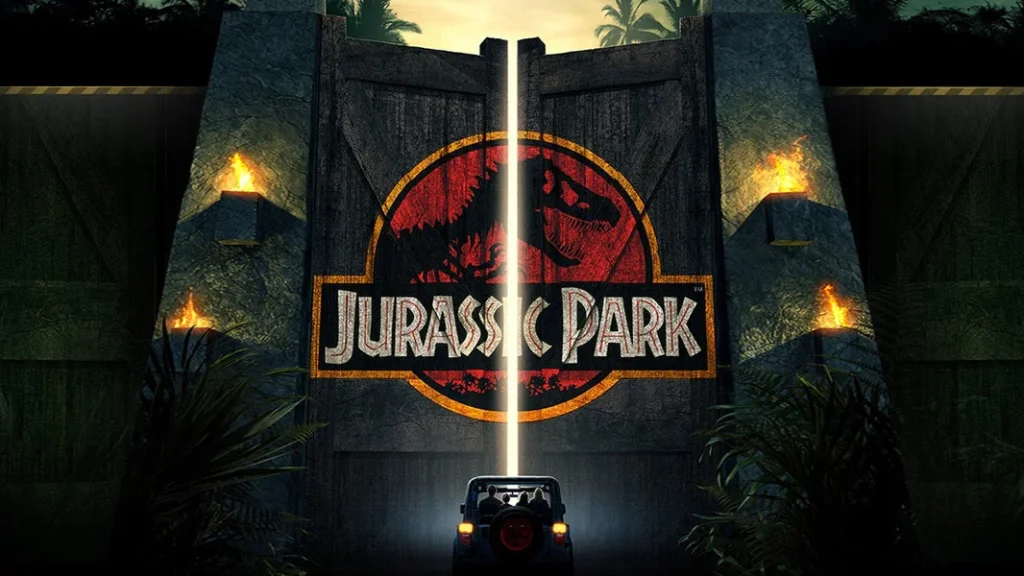
I believe the short answer to this would be yes, but the long answer becomes much more complicated. Released in 1993, Spielberg’s dinosaur blockbuster follows architects Dr Alan Grant (Sam Neill) and Dr Ellie Sadler (Laura Dern) as they are shown around the eponymous Jurassic Park by charismatic Richard Hammond (Richard Attenborough). At the park, Hammond appears to have achieved the impossible and has brought back dinosaurs from extinction. However, due to the actions of self-proclaimed hacker Nedry (Wayne Knight), the dinosaurs are let lose in the park, and Grant and Sadler must find a way to survive.
Jurassic Park is often celebrated for its originality and its visuals, being one of the first movies to make use of Computer-Generated Imagery (CGI). Massively successful upon its release, becoming the highest grossing movie of all time for four years, Jurassic Park has achieved legendary status, spawning an ongoing movie franchise and John Williams’ iconic theme becoming many a phone ringtone. Granted the rare opportunity to revisit this projected in glorious 35mm at the Warwick Arts Centre, I wanted to see how the movie has stood the test of time.
I was still just as blown away sat in my seat as I was putting this into my television for the first time eleven years ago as an eight-year-old boy. Combining Spielberg’s wonder filled direction with John Williams score never fails to bring a smile to my face. This Spielberg/Williams combination even made me cry with this year’s Disclosure Day. Whether you have seen this film once, or thirty times, Hammond’s infamous “Welcome, to Jurassic Park” makes you feel as if you are actually seeing dinosaurs on screen. Despite technological advancements, later Jurassic films haven’t been able to recreate this sense of wonder, which I feel like is due to a lack of a mixture of practical and visual effects to create the dinosaurs. Whilst the CGI dinosaurs are stunning, I much prefer the animatronics and puppetry used in multiple sequences, most infamously the velociraptors attacking Sadler in the maintenance shed. It reminds us that, to the characters, these dinosaurs are real, not digital creations but actual living, breathing organisms. Whilst the animatronics aren’t exactly breathing, I feel they do bring a sense of realism to the scenes, which is odd to say about a film with dinosaurs!
Thematically, all the usual Spielberg bells and whistles are present, perhaps due to frequent Spielberg collaborator David Koepp assisting Michael Crichton, author of the source material the film is based on, in penning the screenplay. Spielberg maintains a sense of the supernatural grounded in a realistic setting, humanity deciding to play god and experiment with things they can’t understand and a relatable emotional core. Like most Spielberg films, family is at the heart of Jurassic Park, and it is Alan Grant’s acceptance of the idea of fatherhood through looking after Hammond’s grandchildren Tim (Joseph Mazzello) and Lexi (Ariana Richards) that fuels the narrative. It is this combination of the supernatural with the natural familial setting that I believe Spielberg excels at, and it is obvious his parents’ divorce has affected this.
In a cast of A-Listers including Neill, Dern, Jeff Goldblum and Samuel L. Jackson, it is tough to pick a favourite performance and character. Granted, Wayne Knight plays Nedry with a comedic yet antagonistic touch and Neill, Attenborough and Goldblum approach their roles with effortless charisma. But, for me, I have always admired Bob Peck’s Kenyan hunter Robert Muldoon. Being the first character we are introduced to, Muldoon is portrayed as a tough, no-nonsense enforcer who always puts the safety of Jurassic Park at the forefront, but at the same time has an undeniable love of the hunt. He takes a special interest in the deadly Velociraptors, an interest that unfortunately leads to his folly. After appearing in such an iconic film, it’s clear that Peck was destined to reach a new career outside of English Dramas, but he unfortunately passed away from cancer in 1999 at 53 years old. A shame, because I feel he really shined as Muldoon.
Finally, I would like to briefly touch on the 35mm format I viewed this in, and how I believe physical film is integral to the nuance and artistry of cinema. Whilst the over 30-year-old print did show evident wear and tear, it does bring a comfort knowing that you are viewing something being threaded into a projector, instead of just projected from a computer. Not only are you seeing the pure film, but you know that somebody in the projection booth is working hard to give you the best experience, instead of just pressing a button on a computer. It reminds me of when my father went to go and see Adam McKay’s Vice in 2019, and when he complained about the film starting at the halfway point, he was told that it would take a while to be reset, as the projections were controlled by the head office in London. Whilst digital projection does result in a crisper image, I believe with physical film there holds a certain roughness that is both satisfying to the viewer visually, and in the knowledge that somebody is physically projecting the film. I give praise to certain cinemas and projectionists worldwide keeping this format alive.
Overall, rewatching Jurassic Park on 35mm was an incredible experience. The movie contained the same blend of science fiction, horror and family drama I grew up loving, whilst also providing a new experience by viewing a film exactly as it was projected 33 years ago. If you are ever given the opportunity to rewatch either this or any Spielberg film in 35 or 70mm I definitely recommend you take it. You’ll leave with a newfound appreciation for both the film and physical media.
5 stars.