For the last 5 years, I have had a deep and constant admiration for the work of Martin McDonagh. Since my father started discussing Three Billboards Outside Ebbing Missouri with me when I was 13, and me eventually watching it a year later, I have remained one of his biggest fans and admirers. I still remember me and my father going to watch the Banshees of Inisherin at 9pm one Thursday in 2022 and just being spellbound by what was on screen.
For me, McDonagh’s work manages to find that perfect melancholic balance between comedy and sadness that I feel most filmmakers struggle to truly capture. Whilst we laugh at the funny quips from In Bruges, we also remember Ray (Colin Farrell) is struggling with guilt after having just accidentally murdered a child, whilst Ken (Brendan Gleeson) has been told to assassinate his best friend whilst on their holiday.
It is this similar structure that makes up Wild Horse Nine.
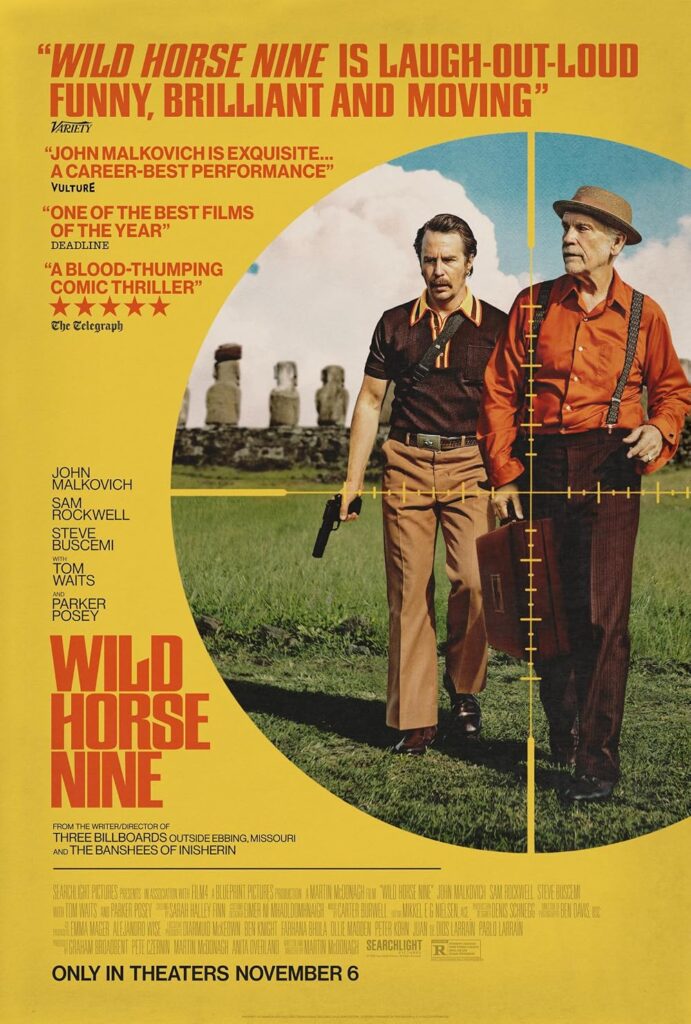
In the film, CIA Agents Chris (John Malkovich) and Lee (Sam Rockwell) take a break from monitoring the political situation in 1973’s Chile to visit the prolific Easter Island as part of a final wish made by Chris, who is dying from cancer. Determined to write his memoirs, Chris starts to document his past, which worries CIA head M.J. (Steve Buscemi) who orders Lee that Chris must be silenced, at all costs.
Whilst some viewers have taken criticism at these borrowed plots from McDonagh’s other work (one character in Three Billboards is also dying from cancer) I think what sets Wild Horse Nine apart is a sense of politicism and a fascination with the afterlife that accentuates the narrative. Not only can the 1973 Chilean setting draw comparisons to the modern-day silencing of political figures (Lee and Chris are essentially waiting in Chile for the American Government to overthrow the newly elected Marxist president) but the assassination of JFK and its impact on American society is also touched upon. But what drives the film for me is the friendship between Chris and Lee and the difficult situations they have been placed in. Chris finds himself at odds with his Catholicism and the fact that he is rapidly losing his memory, hence the urge to record his memoirs, and Lee is placed in the difficult situation of either following his orders or helping his best friend, whilst also being threatened by M.J. with the murder of his wife Marge (in a hilarious bit part from White Lotus’ Parker Posey).
Touching briefly on the cast, of course the main actors on display here are John Malkovich and Sam Rockwell, who are basically given the whole film to work off each other with a great sense of dark humour. There is an excellent scene between the pair where Malkovich reveals what his real final wish truly was, and Rockwell’s facial expressions just become increasingly confused as Malkovich rambles, but Rockwell makes sure to never go over the top. This subdued absurdist dark humour is what makes Rockwell my favourite actor, that doubled with the fact that no matter the project Rockwell always gives it his all, without never going too far. I am a particular fan of his performance as closeted gay Nazi Captain K in Jojo Rabbit, especially the reveal of his provocative outfit in the final act he has spent the whole film designing. However, whilst it would be easy for me to label Rockwell as the best actor in this film, Malkovich is on a completely different level. Whenever you see Malkovich on screen you are instantly on the verge of tears and just want to give him a massive hug and tell him everything will be okay. He also delivers some excellent one-liners in the film, one concerning Archduke Franz Ferdinand was my favourite, and had me howling with laughter in my early screening as part of the London Film Festival.
Outside of Malkovich and Rockwell are a great ensemble cast of B and C list actors who deliver funny performances. Although brief, Buscemi’s performance as M.J. is very humorous and is akin to his performance as Nikita Khrushchev in Armando Iannucci’s The Death of Stalin. There is also a satisfying payoff to a joke that runs throughout the film concerning assumptions made by Chris about M.J.’s character. Parker Posey and Tom Waits have nice brief moments as Lee’s wife Marge and Chris’ estranged folksinger brother Jim (really fitting for Waits when you think about it), and South American actresses Mariana di Girolamo and Ailín Salas as revolutionary students Chris befriends do well to provide a Chilean insight to the political situation.
Overall, without going into spoilers, this is McDonagh at top form with his trademark melancholic dialogue, narrative that considers morality and death, a folksy western score and a top-notch cast delivering entertaining performances. All of this is accentuated through his 70s aesthetic, with some of the film being shot on 16mm film. I went into this film expecting to enjoy it, but I didn’t expect to find one of my favourite films of all time and have my admiration for McDonagh and Rockwell deepened. This is a fabulous masterpiece that I urge every youngster to go out and enjoy when it has its general release next month.
5 stars.
Also, not the first film that features John Malkovich as an old C.I.A. agent who finds himself writing his memoirs. Burn After Reading fans where you at?
Wild Horse Nine is in cinemas from the 4th November.